



This is not an indictment of modern undergarments, but a necessary exploration of cultural history that often remains unaddressed.
Let us journey back to Ancient India.
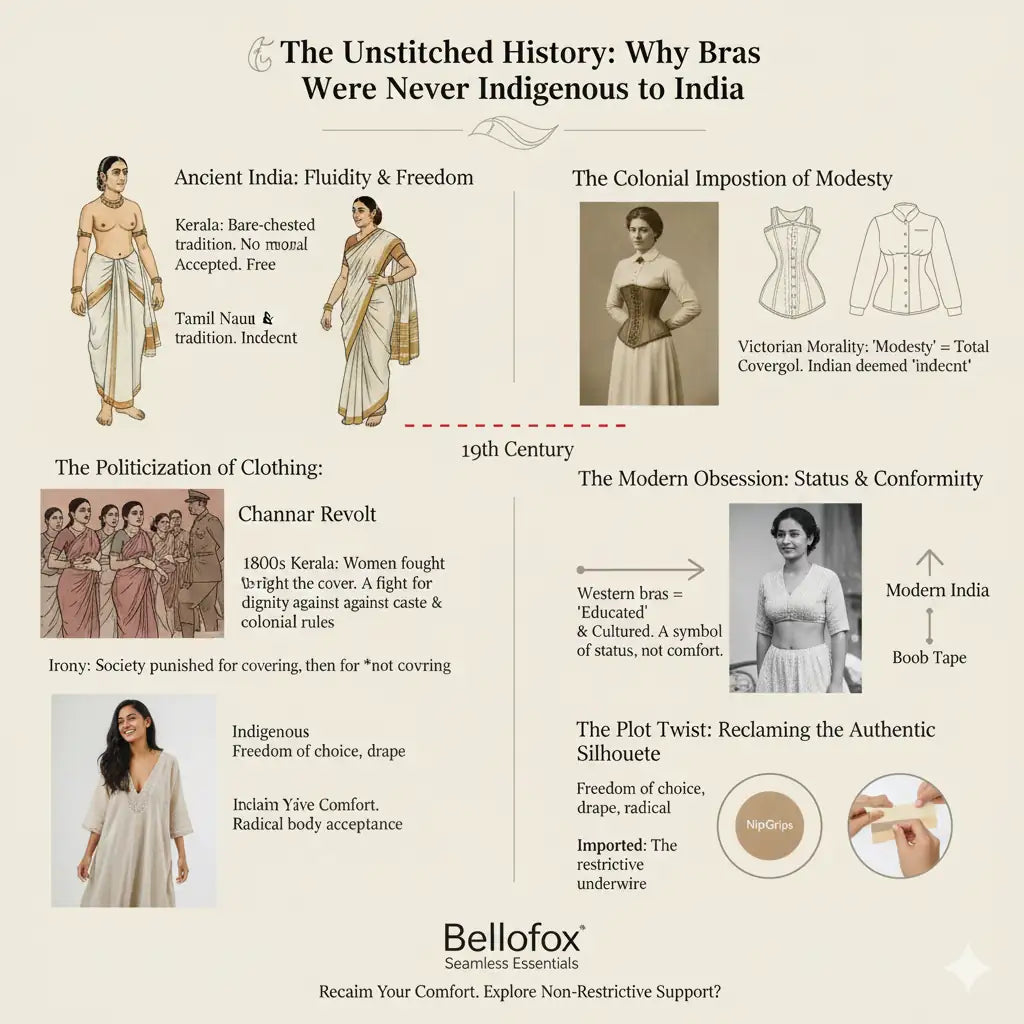
The historical record indicates that traditional Indian attire was characterized by fluidity, functionality, and a remarkable degree of bodily freedom rarely seen today. Concepts like tight, molded blouses, restrictive corsetry, or structured brassieres were absent.
-
Regional Norms: In regions like Kerala, it was customary for women—particularly from certain castes—to be bare-chested. Across Tamil Nadu, Odisha, and parts of Bengal, women utilized simple fabric drapes over their bodies, often forgoing any form of stitched upper garment. This was a reflection of accepted social norms, free from public censure or moral judgment.
The Colonial Imposition of Modesty
The narrative shifts dramatically with the arrival of British colonizers in the 19th century. The conquest was not merely territorial; it was a cultural imposition driven by Victorian morality. This doctrine equated "modesty" with total coverage, corseting, and stringent control over the female body.
The sight of a woman draped in a sari without a stitched blouse or a structured "bra-like" upper cloth was deemed offensive and "indecent" by the British standards. They began systematically introducing their moral code, advocating for stitched clothing, shape-enhancing undergarments, and, eventually, the precursor to the modern bra. This shift was rooted in colonial morality, not local necessity or comfort.
The Politicization of Clothing: A Fight for the Right to Cover
The subsequent cultural upheaval highlights the profound politicization of female dressing.
A stark example is the Channar Revolt (or Upper Cloth Revolt) in Kerala. Here, the societal rules imposed by the caste system explicitly forbade lower-caste women from covering their breasts. When these women began asserting their inherent right to wear an upper cloth (mel mundu), they were met with severe social and physical violence. Women literally had to fight for the right to wear clothes—demonstrating how profoundly intertwined dress became with caste politics and colonial-backed moral policing.
Decades later, an unsettling irony emerged: the same society that had once punished women for covering up was now actively policing them for not covering up enough.
The Modern Obsession: Status and Conformity
As urban India underwent rapid modernization, adopting Western-style stitched blouses and structured brassieres became intertwined with notions of status and social standing. The adoption of these foreign sartorial ideas became a symbol of perceived "education" or "culture." Bras, padded cups, and shaping lingerie transitioned from a foreign concept to a cultural standard, driven not by ergonomic need but by a powerful, internalized societal pressure to conform.
The Plot Twist: Reclaiming the Authentic Silhouette
The clothing choices we often hesitate over today—the comfort of a loose drape, the freedom of a braless look—are, historically speaking, more authentically "desi" than the restrictive underwire.
The discomfort or constraint you may feel in a tightly wired bra is not a biological necessity; it is a legacy of colonial-era restrictions stitched into the modern wardrobe.
Fortunately, a profound shift is underway. Women are now actively choosing comfort, function, and bodily freedom over outdated expectations. We are seeing the embrace of minimalist solutions like nipple covers, adhesive tapes, and stick-on support—or opting for nothing at all.
The core truth is this: Bras were never indigenous to India. What was indigenous was the freedom of choice, the elegance of drape, radical body acceptance, and comfort. The remainder is an imported cultural expectation.
The next time you feel compelled to wear a restrictive garment "just because," ask yourself a critical question: Whose rulebook am I actually following?
Would you like to explore modern, non-restrictive support options like Nipgrips or Boob Tape that align with this new era of freedom?